


Quick Answer: For many solid-walled UK homes, external wall insulation is worth considering because it can reduce heat loss and improve comfort. However, savings vary by property. Wall condition, damp, exposure, installation quality and how the home is heated can all affect the result.
Solid-walled homes lose heat differently from cavity-wall properties because there is no cavity to fill. External wall insulation for solid wall houses adds insulation to the outside of the masonry, helping reduce heat loss without taking internal floor space. It can improve comfort, but suitability depends on the wall condition, damp, exposure and installation quality. This article looks at the benefits, downsides, costs, regulations and alternatives.
Key Takeaways
- External wall insulation can reduce heat loss and improve comfort in solid-walled homes.
- Real-world savings often come in below modelled or EPC predictions, so headline percentages need caution.
- Wall condition, damp and exposure should be assessed before an insulation system is selected.
- Planning permission or Building Regulations approval may apply depending on the property and scale of work.
Is External Wall Insulation Worth It for a Solid-Walled House?
Yes, external wall insulation can be worthwhile where a home has uninsulated solid walls, is heated for long periods and has been properly assessed before installation.
The potential savings can be meaningful. According to the DEEP project research on solid wall insulation savings, solid wall insulation alone was modelled to reduce heating bills by around 11% to 29%. That rose to up to 33% when combined with other retrofit measures.
The same research found that actual savings were generally lower than EPC predictions. That matters because a quoted percentage should never be treated as a guaranteed bill reduction for every home.
What Exactly Is External Wall Insulation?
External wall insulation is insulation fixed to the outside of a solid masonry wall. It creates a new insulated layer around the building rather than filling a cavity that does not exist.
The system normally involves fixing insulation boards or batts to the wall, followed by a reinforcing basecoat and mesh. A weather resistant render or cladding finish is then applied over the system.
This increases the wall’s thermal resistance, helping reduce heat escaping through the masonry. It can also keep internal wall surfaces warmer and reduce some thermal bridging around wall junctions.
Common materials include:
- Mineral wool
- EPS and wood fibre.
Cork-based systems are another option. The suitable material depends on the wall construction, moisture conditions and requirements of the building.
What Types of External Wall Insulation Are Available?
The right EWI material depends on the construction of your walls, the level of thermal performance required and how the existing building handles moisture.
External wall insulation comes in several materials. Each has different thermal, fire, moisture and thickness characteristics. The main options include:
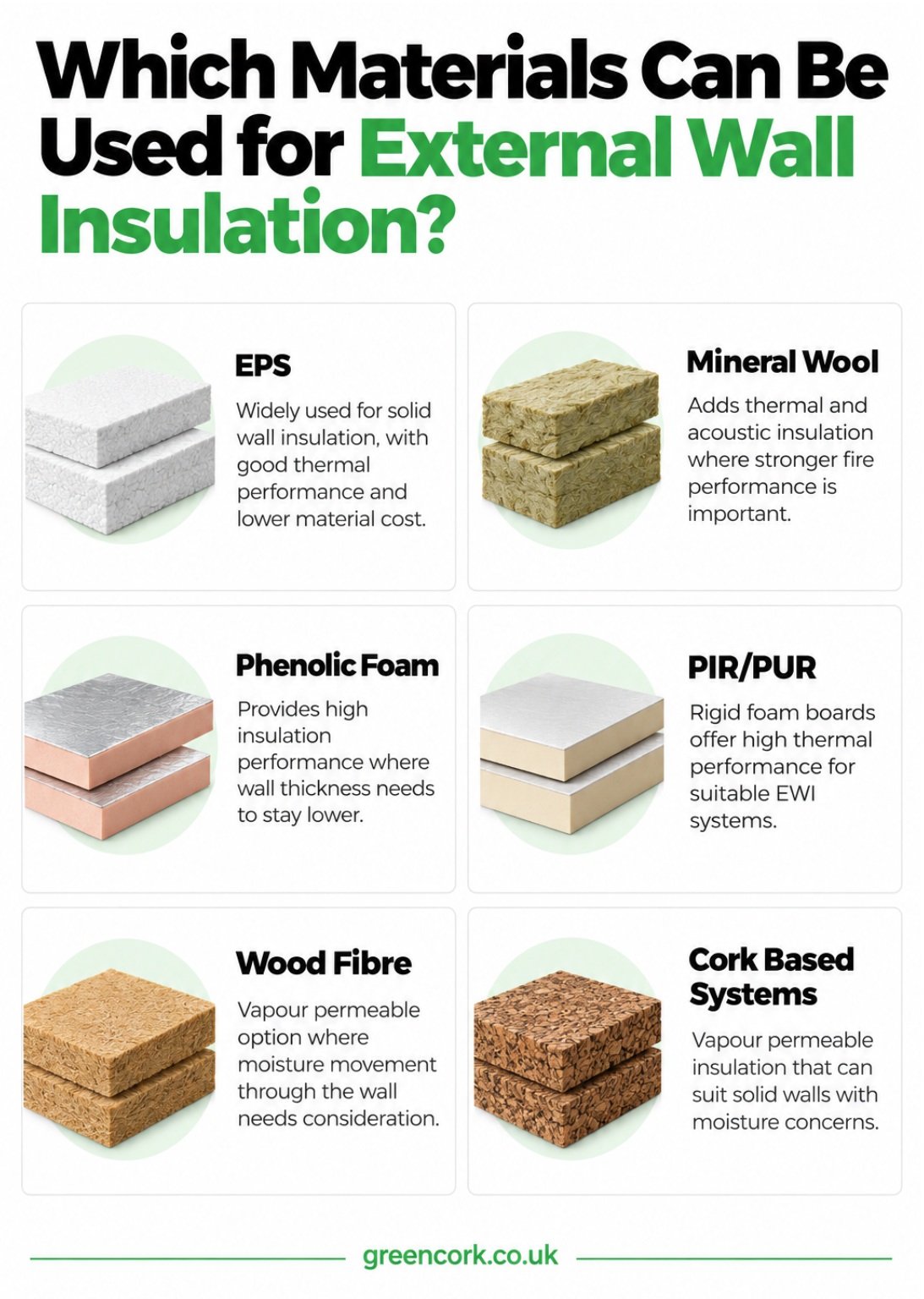
The insulation board is only one part of the EWI build up. Each material needs to work with the adhesive, fixings, reinforcement layer and external render specified for that system. This is why you cannot choose an insulation board in isolation. The complete system needs to be suitable for the existing wall construction and installed to the manufacturer’s specification.
What Are the Benefits and Downsides of External Wall Insulation?
External wall insulation can improve thermal performance without taking space from internal rooms. It can also change the outside of the property, so practical and design issues need to be considered before work begins.
Here are some of the key benefits and potential limitations to consider before choosing external wall insulation:
| Factor | Benefit | Downside / Limitation |
|---|---|---|
| Heat loss | Helps reduce heat escaping through external walls | Performance depends on wall construction and insulation specification |
| Thermal bridging | Can reduce cold spots and heat loss at wall junctions | Poor detailing can leave thermal bridges behind |
| Internal space | Improves insulation without reducing room space | Makes the external wall thicker |
| Moisture management | Can improve thermal performance when correctly specified | Poor material selection or detailing can create moisture problems |
| Windows and roof edges | Allows insulation to form part of a more continuous envelope | Window reveals, sills, eaves and gutters may need alterations |
| Appearance and cost | Provides an opportunity to renew the external finish | Changes the property's appearance and involves significant upfront cost |
These trade-offs highlight why EWI (External Wall Insulation) needs to be designed around the existing building rather than treated as a simple insulation layer. The INCA External Wall Insulation Best Practice Guide stresses the importance of checking the wall, managing moisture, addressing thermal bridging and considering ventilation before installation.
Can External Wall Insulation Help With Damp?
Yes, external wall insulation can help reduce some forms of damp, but it will not repair the underlying cause of a leak or building defect.
Adding insulation can help keep internal wall surfaces warmer. A weather resistant outer finish can also reduce rain reaching the masonry. This may help where wind-driven rain and cold wall surfaces contribute to moisture problems.
It will not fix:
- A leaking gutter
- Defective roof
- Plumbing leak
- Failed pointing
- Or any other source of water ingress.
The wall should therefore be checked first. Cracked render, damaged pointing and saturated masonry should be dealt with before an insulation system is installed. Existing moisture trapped behind a new system can create further problems if the cause has not been resolved.
How Much Does External Wall Insulation Cost?
External wall insulation costs vary according to property size, the condition of the existing walls and the system being installed.
Wall area is the starting point, as a larger surface needs more insulation, fixings and finishing materials. However, the property itself can make installation more complex. Multiple storeys, restricted access or awkward elevations can increase scaffolding and labour costs.
The wall condition also matters. Damaged render, cracked masonry or defective pointing may need repair before insulation is fitted. Windows, roof edges, gutters, pipes and external fittings can then require alterations to accommodate the added thickness.
Finally, the insulation material, required thickness and chosen render or cladding finish will affect the price.
For current guide figures and a breakdown, see our external wall insulation cost guide.
Are Grants Available?
Funding for insulation can be available through government backed schemes, but eligibility depends on the household, property and scheme requirements. ECO4 currently runs until 31 December 2026 and can support eligible insulation measures, including external wall insulation for qualifying solid walls.
The Ofgem ECO4 guidance sets out the current eligibility and measure requirements. You can also check the government’s home insulation funding guidance for current information before assuming you qualify.
The Great British Insulation Scheme ended on 31 March 2026, so older references to it should not be treated as a current funding option.
What Happens During External Wall Insulation Installation?
A proper installation starts by checking whether the building and wall are suitable for the chosen system.
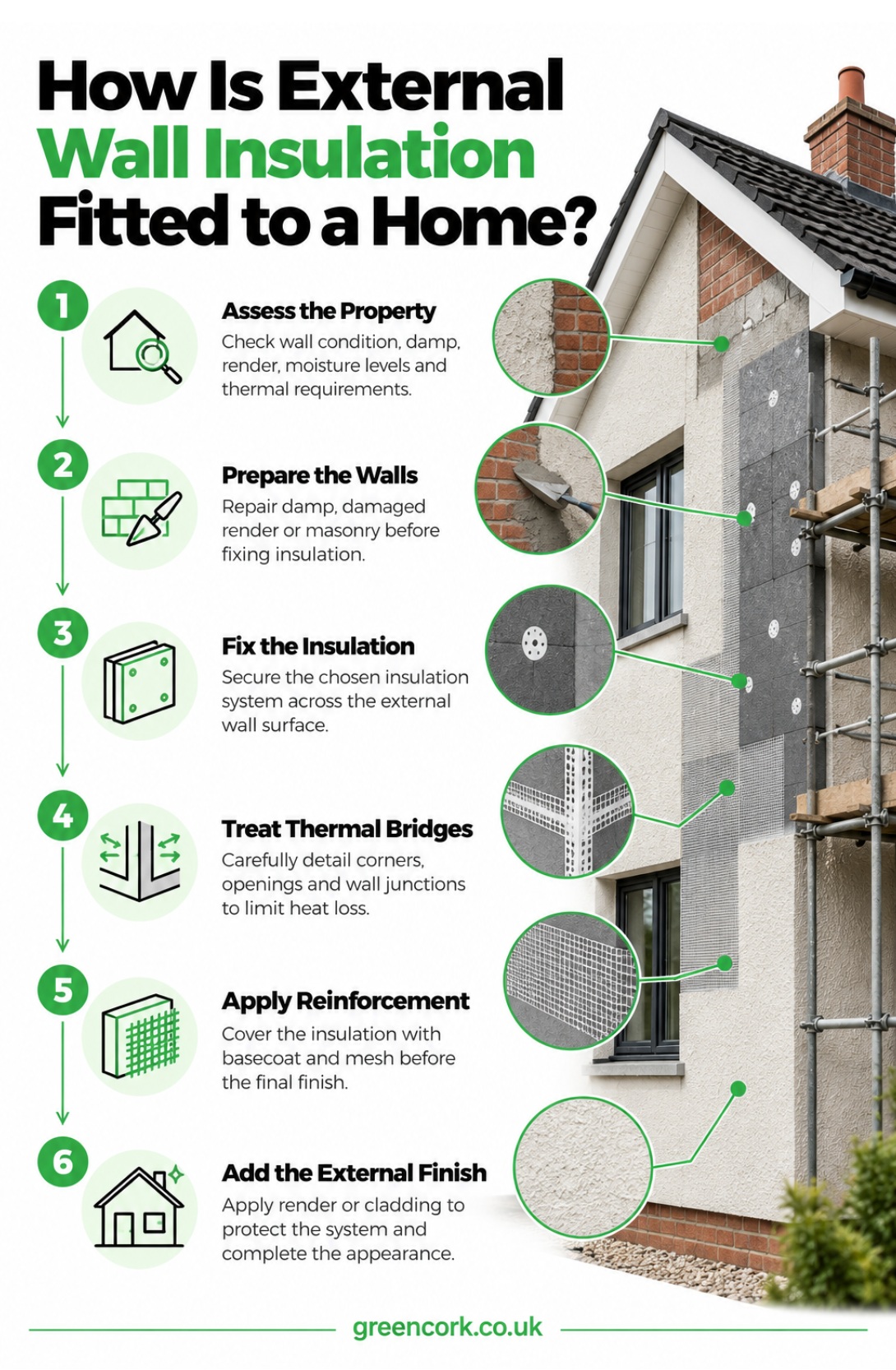
The main stages include:
Property Assessment
The wall is assessed for condition, damp and existing render. A U-value calculation and condensation analysis may be needed. A structural survey may also be appropriate where the building or fixings require further investigation.
Wall Preparation
Any existing problems need to be addressed before the insulation goes on. This can include dealing with damp, repairing damaged render and making sure the masonry can accept the proposed fixing system.
Insulation Installation
The insulation layer is fixed to the wall as part of a designed system. Thermal bridges need careful attention, particularly around junctions and openings. Ventilation also needs to be considered because the finished building envelope may be less draughty.
External Finish
A reinforcing basecoat and mesh are applied before the final render or decorative finish. This protects the insulation system and gives the property its new external appearance.
How Does External Wall Insulation Compare With Internal Insulation
Neither option is automatically better. For a solid-walled home, the right choice depends on the property, available space, wall condition and how much disruption you are prepared to accept.
External insulation is fitted outside the wall, so it keeps internal rooms intact. It can cover more of the wall continuously and may reduce thermal bridging. However, it usually needs scaffolding, changes to external details and a new render or cladding finish.
Internal insulation is fitted inside the rooms. It avoids changing the external appearance, but it takes up floor area and can disrupt rooms during installation. Detailing around windows, floors and internal walls also needs care.
EWI can suit homeowners who want to retain internal space. Internal insulation may suit properties where changing the exterior is difficult or restricted.
FAQs
Is external wall insulation worth it for a solid brick house?
It can be, particularly where walls are uninsulated, the home is heated regularly and the building is suitable for a properly designed system.
How much does external wall insulation cost?
A typical project can cost several thousand pounds. Property size, access, wall repairs, insulation type and finish all affect the final price.
Can external wall insulation cause dampness?
It can create moisture problems if an existing damp issue is ignored or the system is poorly designed. The wall should be assessed first.
Can external wall insulation reduce energy bills?
Yes. Research has modelled meaningful bill reductions, but actual savings vary and can come in below EPC or modelled predictions.
Is external or internal insulation better?
Neither is automatically better. External insulation retains internal space, while internal insulation can avoid changing the property’s exterior.
Do you need planning permission for external wall insulation?
Planning permission may be needed in some protected areas. Listed buildings may also need listed building consent.
Conclusion
External wall insulation can be worthwhile for a suitable solid-walled home, particularly where heat loss is high and the property is heated regularly. Wall condition, damp, exposure and external restrictions all need checking first. A proper assessment is the best way to establish whether EWI makes financial and practical sense.
Get your free quote for a free, no-obligation survey and quote from GreenCork.