


Quick Answer: Solid wall insulation can improve summer comfort, but placement matters. External insulation helps regulate indoor temperatures, while internal insulation needs good ventilation and shading to reduce the risk of overheating.
As energy bills remain high, many homeowners install solid wall insulation to stay warmer during winter. But with UK summers becoming hotter, comfort in warm weather matters too. So, can solid wall insulation help keep your home cooler?
The answer is yes, but it depends on where the insulation is installed and how your home manages heat during summer.
Key Takeaways
- Around 8 million UK homes have solid walls, and most weren’t designed with summer overheating in mind.
- Internal wall insulation can actually raise summer indoor temperatures by cutting the room off from the wall’s natural thermal mass.
- External wall insulation, like Spray Cork, tends to preserve thermal mass and perform better during hot weather but ventilation and shading still matter just as much.
Why Do Some Homes Get Hotter Than Others During a Heatwave?
Some homes heat up much faster than others during a heatwave.
Older solid wall properties, especially those built before the 1920s, are often more vulnerable because they were designed to keep heat in during winter, not stay cool in summer.
Modern overheating standards simply did not exist when they were built. Although Building Regulations Part O now requires new homes to reduce overheating risk, these rules do not apply to the existing solid wall homes where insulation upgrades are most common.
The problem is only getting bigger.
Research by Arup for the Climate Change Committee found that around half of existing UK homes already face some level of overheating risk. Under a 2°C warming scenario, that figure could rise to around 90%.
Hot homes are not just uncomfortable.
During England’s hottest days in 2022, ONS data linked more than 4,500 deaths to extreme heat. As hotter summers become more common across the UK, keeping your home cooler is becoming just as important as keeping it warm in winter.
How Does Heat Enter Your Home Through Solid Walls?
A home can warm up surprisingly quickly during hot weather, especially if several sources of heat are working together. Direct sunshine, warm outdoor air, everyday activities and the walls themselves all play a part.
The amount of heat that builds up depends on your home’s construction, layout and how it’s used throughout the day.
The four main ways heat builds up in a solid wall home are:
Sunlight Heating the Building
Direct sunshine warms the roof, walls and windows all day long. How much heat builds up depends on your property’s orientation, how much shade it gets and what surrounds it.
A south-facing brick terrace with no trees nearby will absorb far more solar heat than a shaded north-facing property.
Heat Moving Through Solid Walls
Solid walls conduct heat straight from outside to inside. Unlike cavity walls, there’s no air gap to slow things down. So the same walls that lose heat quickly in winter can gain it just as easily in summer.
Warm Air Entering the Home
Opening windows during the hottest part of the day feels instinctive, but it can work against you. Hot outdoor air flows in, raising the indoor temperature rather than cooling it down.
Heat Building Up Indoors
Cooking, appliances, lighting and even the people in the room all generate heat. When that heat can’t escape easily, it accumulates. By evening, the indoor temperature can be significantly higher than it was at midday.
Does Insulating a Solid Wall Home Cause or Prevent Overheating
Whether solid wall insulation improves summer comfort depends on how the system interacts with the building, not simply on the insulation itself. The position of the insulation affects how heat is stored, transferred and released, which is why different systems can produce different results during hot weather.
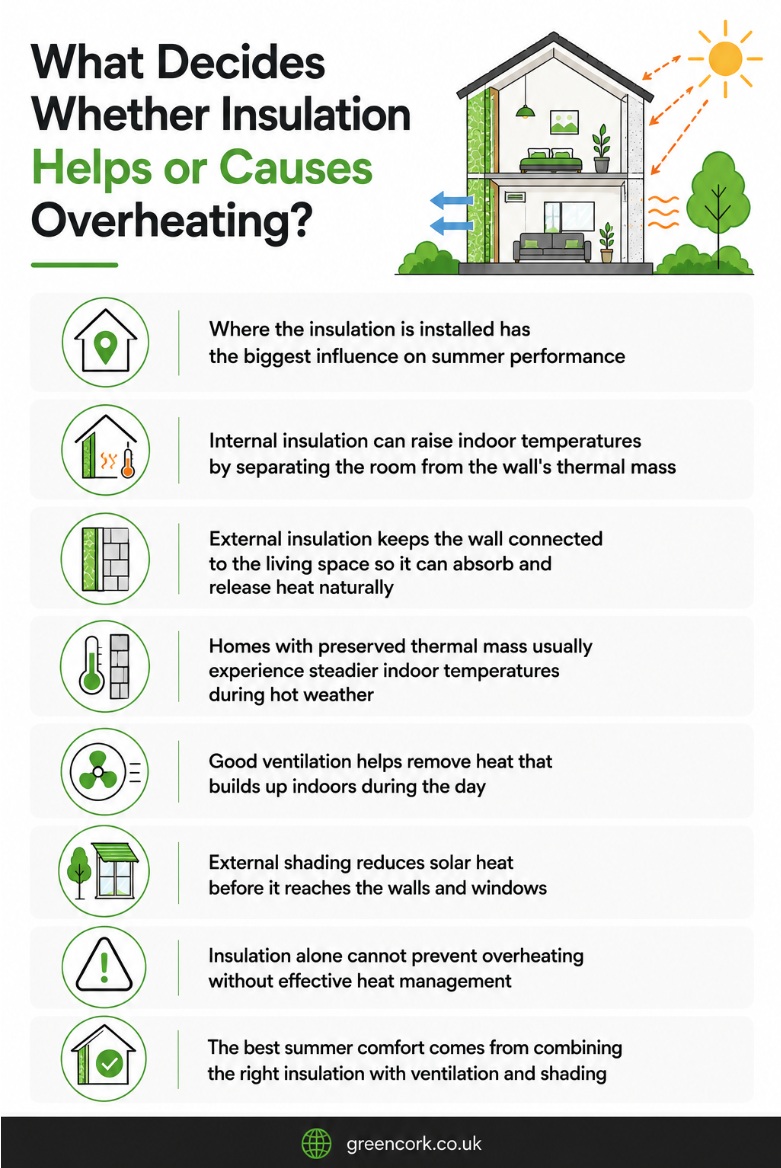
Internal and external insulation behave very differently in summer.
The position of the insulation layer changes the relationship between the room and the wall’s thermal mass, which is the wall’s natural ability to absorb and slowly release heat.
Internal Wall Insulation
A Loughborough University field study monitored two similar solid wall homes over four weeks during summer. One had internal wall insulation, while the other remained uninsulated.
The insulated home recorded higher indoor temperatures.
This happened because the insulation sat between the room and the brick wall, preventing the wall from absorbing heat during the day and releasing it more gradually later on. Overheating mainly occurred once outdoor temperatures rose above around 30°C.
The study also found that simple measures, such as better ventilation and external shading, reduced peak indoor temperatures by roughly 2°C.
External Wall Insulation
External wall insulation works differently.
The insulation is fixed to the outside of the wall, leaving the brick or stone exposed to the room inside. This allows the wall to keep absorbing heat during the day and releasing it gradually as temperatures fall.
Because the wall’s thermal mass is preserved, external wall insulation is generally considered the better option for improving summer comfort in solid wall homes.
Ventilation and Solar Gain
Insulation is only part of the story.
Night-time ventilation, external shading and reducing direct solar gain all make a significant difference to indoor temperatures, regardless of which insulation system you use.
Think of insulation as one tool in the box, not the whole toolkit.
Why Insulation Type and Placement Matter More Than Insulating Itself
Two homes can have solid wall insulation and perform very differently during summer. The difference often comes down to the type of insulation used, where it is installed and how the home is ventilated.
The table below summarises how internal and external wall insulation tend to differ in summer performance:
| Factor | Internal Wall Insulation | External Wall Insulation |
|---|---|---|
| Thermal mass exposure | Removed from room air | Preserved |
| Summer temperature effect | Can raise peak indoor temperatures | Generally more stable |
| Best paired with | Ventilation and shading | Ventilation and shading |
| Winter performance | Strong | Strong |
Both systems perform well in winter. But when summer arrives, external insulation holds a clear advantage for solid-wall homes.
How Can Spray Cork Improve Thermal Comfort in Summer
If external insulation is the stronger choice for summer comfort, Spray Cork is worth understanding properly. It’s an externally applied sprayed cork coating that insulates the wall from the outside, which ties directly into the research findings above.
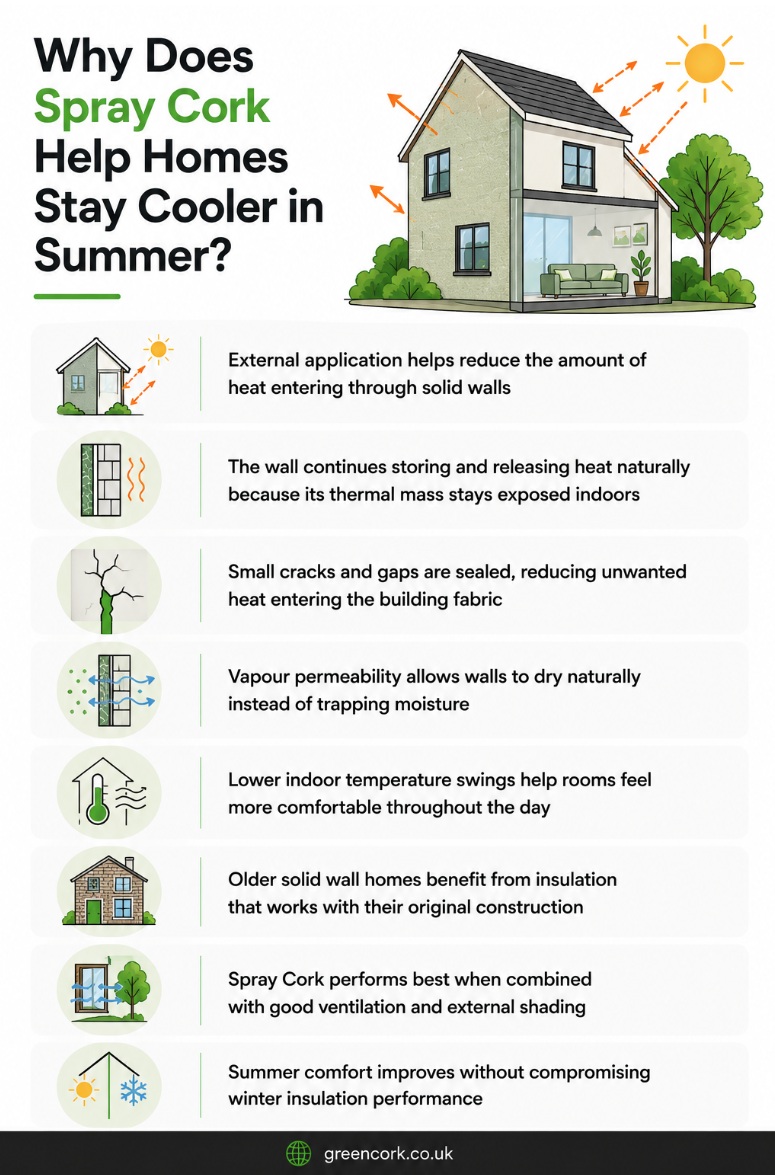
These are the practical reasons why externally applied Spray Cork is used to improve thermal comfort in solid wall homes. Every property is different, so the right solution depends on the construction and condition of the building.
If you are planning an external wall insulation project, we can assess your property and advise whether Spray Cork is the right choice for your home.
What Else Can You Do to Keep Your Home Cooler During Summer
Good insulation slows heat moving through your walls, but it cannot stop every source of unwanted heat. A few everyday habits can make it easier to keep indoor temperatures down, especially during long spells of hot weather.
You can help keep your home cooler in summer by:
- Keeping windows, curtains and blinds closed during the hottest part of the day.
- Using external shutters, awnings or blinds to stop direct sunlight reaching your windows.
- Using internal curtains to reduce the amount of sunlight entering your rooms.
- Opening windows once the outside air becomes cooler than the air indoors.
- Opening windows on opposite sides of your home during cooler evenings to encourage natural airflow.
- Letting cooler night air remove heat built up inside your home before the next day.
How Is Overheating Risk Assessed in UK Homes
There are recognised ways to assess whether a home is likely to overheat during summer. They are mainly used by architects, designers and building professionals, but they are also useful to know if you are planning a solid wall insulation project.
One is Approved Document O, which became part of the Building Regulations in June 2022. It sets out rules to help prevent overheating in new homes by considering factors such as solar gain, ventilation and window design.
These rules do not apply to existing solid wall homes being retrofitted with insulation.
Another is CIBSE TM59. This is an overheating assessment developed by the Chartered Institution of Building Services Engineers, the professional body for building services in the UK. It looks at how warm a home is likely to get during the year.
For example, it recommends that bedroom temperatures should not stay above 26°C for more than 1% of annual night time hours.
TM59 is not a legal requirement for existing homes. Even so, it is commonly used on retrofit projects to check whether a proposed insulation design is likely to create overheating problems before installation begins.
Is Spray Cork Suitable for Older UK Homes
Older homes need a different approach to insulation.
Many were built with solid brick or stone walls that naturally absorb and release moisture. They also rely on the wall itself to store heat and release it gradually as temperatures change. Using the wrong insulation system can interfere with both.
Spray Cork is designed with these properties in mind.
It is applied to the outside of the wall, so the brick or stone remains exposed to the room inside. That means the wall can continue storing and releasing heat naturally instead of being separated from the living space.
The coating is also vapour permeable, allowing moisture to pass through the wall rather than becoming trapped behind it.
That makes Spray Cork a good fit for many older solid wall homes. It improves insulation while allowing the wall to keep doing its job.
FAQs
Does insulation keep heat out in summer?
Yes, but it depends on the system. External insulation generally performs better, especially alongside good ventilation and shading.
Is internal or external wall insulation better for summer?
External wall insulation is usually the better option because it preserves the wall’s thermal mass and helps regulate indoor temperatures.
Can Spray Cork help keep my home cooler?
Yes. Applied externally, Spray Cork helps reduce heat transfer while allowing the wall to keep storing and releasing heat naturally.
Why do my walls feel hot during a heatwave?
Solid walls absorb heat from the sun during the day and slowly release it indoors, especially during the evening.
Does external wall insulation help keep a house cooler in summer?
Generally, yes. It slows heat entering through the wall while preserving the wall’s natural thermal mass.
Conclusion
Solid wall insulation can improve summer comfort, but the right system makes all the difference. External solutions such as Spray Cork help reduce heat gain while preserving the wall’s natural thermal mass. Combined with good ventilation and shading, they can keep your home comfortable throughout the year.
Get your free quote, and we’ll carry out a free, no-obligation survey to help you find the best approach for your property.