


Yes, you can render over pebbledash and brickwork with SprayCork, which adheres better to textured surfaces than traditional render. It's flexible, breathable, offers thermal insulation, and lasts 25+ years with minimal maintenance.
Thousands of UK homes still feature pebbledash or aged brickwork exteriors that look tired and dated. If you’re wondering whether to refresh your property’s appearance, you’ve probably asked: Can you simply render over these surfaces? While technically possible, success depends entirely on your wall’s condition. Traditional render often struggles with these textured surfaces, but there’s a better alternative that’s changing how homeowners approach this common problem.
Key Takeaways
- SprayCork provides superior adhesion to pebbledash and brick surfaces compared to traditional renders, which often crack and fail on textured exteriors.
- Beyond aesthetics, SprayCork offers thermal insulation (reducing heat loss by up to 30%), breathability, and weather protection with a 25+ year lifespan.
- While initially more expensive than traditional render, SprayCork’s durability, minimal maintenance requirements, and energy savings make it more economical long-term.
Can You Render Over Pebbledash or Brickwork?
Yes, technically, you can render over both pebbledash and brickwork, but not without careful consideration. According to BRE research, about 33% of solid-wall dwellings in England have existing rendered finishes, including pebbledash, showing how common this situation is.
For rendering to succeed, your existing surface must be:
- Clean and structurally sound
- Free from major cracks or hollow areas
- Well-bonded to the underlying wall
- Not suffering from damp issues
The English Housing Survey reveals there are approximately 8.7 million dwellings with uninsulated solid walls in England. About 85% of these are classified as “harder to treat”, often because of external finishes like pebbledash that complicate improvement efforts.
The reality? While traditional rendering over these surfaces is possible, it’s rarely the optimal solution.
Why Traditional Render Often Fails on Pebbledash
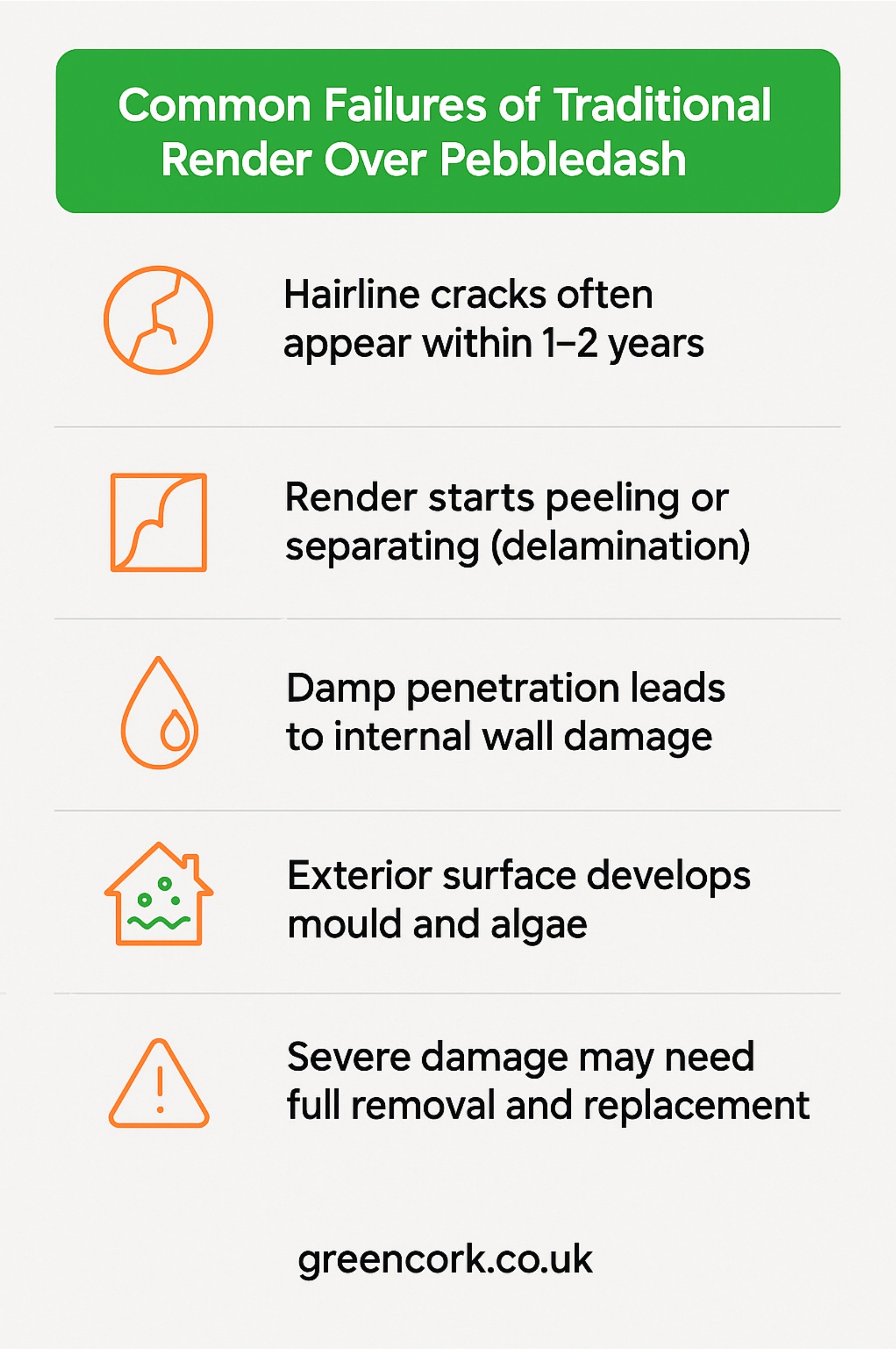
Traditional render struggles with pebbledash for several fundamental reasons. The uneven texture creates adhesion challenges, with render thickness varying dramatically across the surface.
This inconsistency leads to stress points where cracking eventually occurs. The UK weather doesn’t help either. The constant cycle of wetting, freezing, and thawing puts enormous strain on rendered surfaces.
Another major issue is moisture management. Traditional renders can trap moisture against the wall, especially if applied incorrectly over pebbledash. This creates perfect conditions for damp problems to develop inside your home.
Many homeowners discover these issues only years after application, when repairs become expensive and disruptive.
How SprayCork Solves This Problem
Our SprayCork wall coating offers a revolutionary solution to the render-over-pebbledash dilemma. Unlike traditional render, SprayCork bonds effectively to rough and uneven textures thanks to its unique formulation and application method.
The key difference lies in how SprayCork works. Traditional renders try to cover pebbledash, but SprayCork embraces the texture, conforming to it while creating a new surface. This approach eliminates the common failure points of conventional systems.
SprayCork creates a breathable, flexible membrane that moves with your building rather than fighting against it. The natural cork content gives it exceptional elasticity, preventing the cracking that plagues cement-based products.
Technical testing shows SprayCork delivers impressive performance metrics:
- Thermal conductivity of 0.065 W/m·K
- Up to 30% reduction in heat loss through solid walls
- Surface temperature increases of around 3°C on uninsulated walls
- Sound reduction potential of up to 38 dB
- Fire rating of B-s1,d0 to EN 13501-1
When Is SprayCork the Best Option?
SprayCork truly shines in specific scenarios that would challenge traditional renders.
For instance, if a homeowner wants a modern appearance without the disruption of full removal, SprayCork over pebbledash provides an ideal solution. It can transform the exterior with minimal preparation, creating a smooth, contemporary finish that significantly improves the property’s appearance and thermal performance.
Another example is a Victorian brick property in West Yorkshire where the owner wants to preserve the character while addressing cold internal walls. The breathable nature of SprayCork makes it perfect for this historical building, allowing the brick to maintain its natural moisture balance while improving thermal comfort.

Preparation Checklist Before Applying Anything
Proper assessment is critical before any wall treatment. Here’s what needs checking:
| Assessment Area | What to Check | Action Required |
|---|---|---|
| Surface Stability | Tap test for hollow sounds | Remove loose areas |
| Moisture Issues | Damp patches, salt deposits | Address source before coating |
| Structural Integrity | Cracks wider than 2mm | Structural repair may be needed |
| Previous Coatings | Flaking paint, loose material | Remove completely |
| Wall Construction | Solid, cavity or non-traditional | Determines suitable approach |
For failing pebbledash, we:
- Remove loose stones and hollow sections
- Clean the surface thoroughly
- Apply a suitable primer
- Apply the SprayCork system in thin, controlled layers
This methodical approach ensures long-lasting results where other solutions fail.
Benefits of SprayCork Over Traditional Render
SprayCork delivers advantages that conventional rendering simply cannot match:
Superior Flexibility
While traditional renders crack under building movement, SprayCork remains flexible throughout its lifetime, adapting to thermal expansion and minor settlement.
Natural Insulation Properties
Testing shows SprayCork can help reduce heat loss by up to 30% on solid walls, making your home warmer and potentially reducing energy bills.
Breathability With Weather Resistance
Unlike conventional renders that can trap moisture, SprayCork allows walls to breathe while maintaining excellent water repellency.
Sound reduction is another bonus. Lab tests demonstrate potential sound reduction of up to 38dB in certain build-ups, helping create quieter indoor environments.
Cost Comparison: Render vs SprayCork
Initial investment in SprayCork is typically higher than basic render systems, but the lifetime value calculation strongly favours our cork-based solution:
| Factor | Traditional Render | SprayCork |
|---|---|---|
| Initial cost | £30–60 per m² | £60–90 per m² |
| Application time | 3–5 days (plus drying time) | 1–3 days |
| Expected lifespan | 10–15 years | 25+ years |
| Maintenance requirements | Regular painting, crack repairs | Minimal maintenance |
| Energy savings | Minimal | Up to 30% reduction in wall heat loss |
| Property value impact | Moderate improvement | Significant improvement |
The total cost of ownership makes SprayCork the economical choice over time. While the upfront investment is higher, the reduced maintenance needs and energy savings create substantial returns over the system’s lifespan.
Our customers typically report noticeable reductions in heating costs after SprayCork installation, particularly in older properties with solid walls. The combination of improved appearance and enhanced comfort adds significant value to properties.
For our complete range of house rendering services, we offer various solutions to suit different property types and budgets.
Transform Your Property with SprayCork
Upgrading your pebbledash or brick exterior doesn’t have to mean complete removal and rebuilding. Our SprayCork system provides a modern, long-lasting solution that combines aesthetic improvement with practical benefits.
With over a decade of experience transforming properties across Leeds and West Yorkshire, we deliver exceptional results backed by manufacturer warranties and our workmanship guarantee.
Ready to discuss how SprayCork could transform your home? Contact our team for a free quotation. We’ll provide honest advice about the best approach for your specific situation, whether that’s SprayCork or another rendering solution.
FAQs
Can I render directly over pebbledash without any preparation?
No, proper preparation is always necessary. At minimum, the pebbledash must be sound, clean, and free from loose material. SprayCork requires less intensive preparation than traditional render, but surface assessment and cleaning remain essential.
How long does SprayCork typically last compared to traditional render?
SprayCork typically lasts 25+ years with minimal maintenance, while traditional render often requires significant repairs or replacement after 10-15 years due to cracking and adhesion failures.
Will SprayCork crack like traditional render in changing weather conditions?
No, SprayCork’s natural elasticity allows it to flex with thermal movement and building settlement, dramatically reducing the risk of cracking compared to rigid traditional renders.
Can SprayCork help resolve existing damp problems in my walls?
SprayCork creates a water-resistant but breathable barrier that helps prevent rainwater penetration while allowing internal moisture to escape. However, existing damp sources must be addressed before application.
Is SprayCork suitable for listed buildings or conservation areas?
Yes, SprayCork is often appropriate for heritage properties due to its breathability and availability in conservation-friendly colours. We recommend checking with your local planning authority first for listed buildings.
How does the application process affect my daily life during installation?
SprayCork installation is faster and less disruptive than traditional rendering. Most residential projects take 1-3 days, with minimal dust and noise compared to removing and replacing conventional render.